Concrete driveway calculator
Size 5-inch passenger car driveways or 6-inch heavy truck aprons with quarter-yard ready-mix rounding, compacted gravel base tons, and #4 rebar spacing.
- 1 Measure
- 2 Set your price
- 3 Quote & PDF
1 Measure
2 Set your price
USD3 Quote
Rounded to real store units. Edit any unit price to match your local supplier:
| Material | Buy qty | Unit (USD) | Cost |
|---|---|---|---|
Ready-Mix Concrete (3,500–4,000 PSI) Includes +10% waste & grade-unevenness buffer | 7.5 yd³ | $1,260.00 | |
3/4" Crushed Stone Sub-Base (Compacted) 6" compacted base (+10% compaction factor) | 12.5 tons | $600.00 | |
#4 Rebar (1/2" × 20 ft Steel Bars) 18" O.C. grid both ways + 15% lap splice allowance | 36 bars | $495.00 | |
2×4×12 ft Form Lumber 84 lin ft perimeter forming | 8 boards | $62.80 | |
24" Steel/Wood Form Stakes (Bundle of 10) Spaced every 3 ft (28 stakes total) + duplex nails | 3 bundles | $66.00 |
Concrete driveway thickness, PSI & rebar reference
Load-rated slab specs for single-car, two-car, and RV driveways.
Formula & waste allowance
Residential driveways carrying passenger cars should be poured at least 5 inches thick over 4 to 6 inches of compacted crushed stone using 4,000 PSI air-entrained concrete in freeze-thaw zones and #4 rebar tied on an 18-inch grid.
Quick sizing chart
| Driveway layout | Recommended thickness | Ready-mix (+10%) | 6″ stone base |
|---|---|---|---|
| Single-car (10′ × 30′) | 5 in (4,000 PSI) | 5.25 yd³ | 8.0 tons |
| Two-car pad (24′ × 18′) | 5 in (4,000 PSI) | 7.50 yd³ | 11.5 tons |
| Two-car long (20′ × 40′) | 5 in (4,000 PSI) | 13.75 yd³ | 21.0 tons |
| RV / heavy truck (14′ × 40′) | 6 in (4,500 PSI) | 11.50 yd³ | 14.8 tons |
Worked example: 24′ × 18′ two-car driveway at 5″ thick
- Surface area & net volume: 24 ft × 18 ft = 432 sq ft × (5 ÷ 12) ft = 180 ft³ ÷ 27 = 6.67 yd³ net.
- Waste & ready-mix order: 6.67 × 1.10 = 7.33 yd³ → round up to 7.50 yd³ (single full mixer truck).
- Compacted gravel base: 432 sq ft at 6″ deep = 8.0 yd³ × 1.42 tons/yd³ → order 11.5 to 12 tons crushed stone.
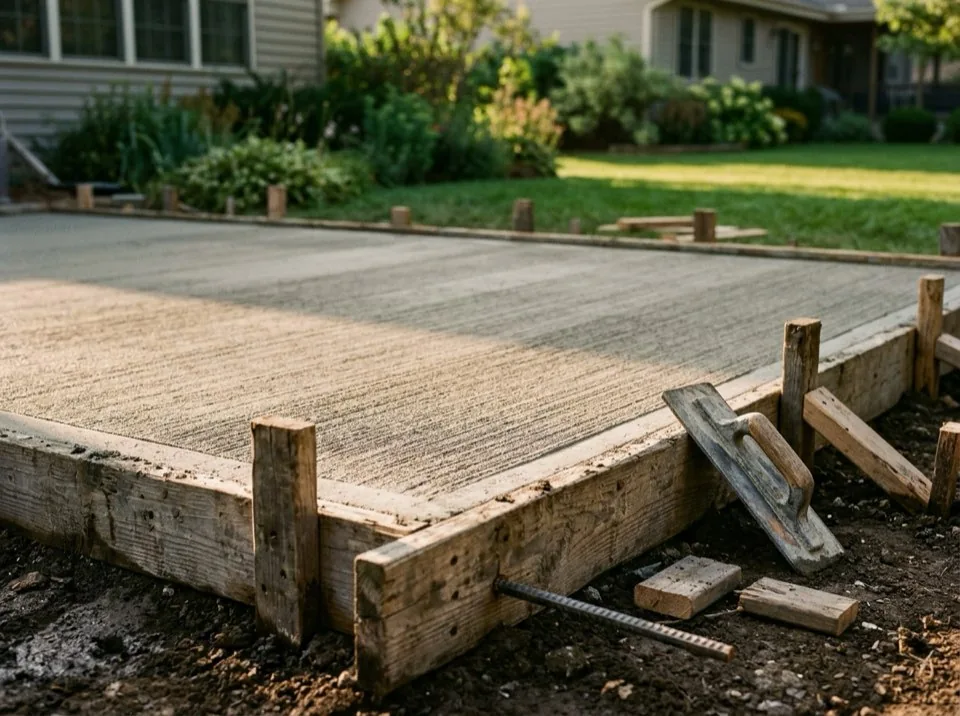
- Control joint spacing: Saw-cut 1.25″ deep control joints every 8 to 10 feet to divide the driveway into near-square panels.
Jobsite checklist
- Specify 4,000 PSI (4,500 PSI with 6% air entrainment in northern freeze-thaw climates).
- Compact subgrade and 6″ gravel base in lifts with a plate compactor before setting forms.
- Chair #4 rebar up 2 inches so steel sits in the middle third of the 5″ or 6″ slab.
- Cut contraction joints within 6 to 12 hours of finishing to control random shrinkage cracking.
Common questions
Should a residential concrete driveway be 4 inches or 5 inches thick?
Pouring 5 inches thick instead of 4 inches adds roughly 25% more concrete volume but increases slab flexural load capacity by over 50%, preventing corner cracking from SUVs, pickup trucks, and delivery vans.
How many cubic yards fit in a standard ready-mix concrete truck?
Most ready-mix mixer trucks carry 9 to 10 cubic yards of concrete maximum due to bridge weight limits. Driveways above 10 cubic yards require two truckloads spaced 20 to 30 minutes apart.
How much does a thickened driveway edge add to concrete volume?
Thickening the outer 12 inches of a driveway apron from 5 inches to 8 inches adds roughly 0.15 to 0.35 cubic yards along a 20-foot garage or street entrance, which a 10% waste buffer helps cover.