Concrete slab & pier calculator
Cubic yards, bags, gravel and rebar for slabs, patios and piers.
- 1 Measure
- 2 Set your price
- 3 Quote & PDF
1 Measure
2 Set your price
USD3 Quote
Rounded to real store units. Edit any unit price to match your local supplier:
| Material | Buy qty | Unit (USD) | Cost |
|---|---|---|---|
Ready-Mix Concrete (3,500–4,000 PSI) Includes +10% waste & grade-unevenness buffer | 4 yd³ | $672.00 | |
3/4" Crushed Stone Sub-Base (Compacted) 4" compacted base (+10% compaction factor) | 5.5 tons | $264.00 | |
#4 Rebar (1/2" × 20 ft Steel Bars) 18" O.C. grid both ways + 15% lap splice allowance | 23 bars | $316.25 | |
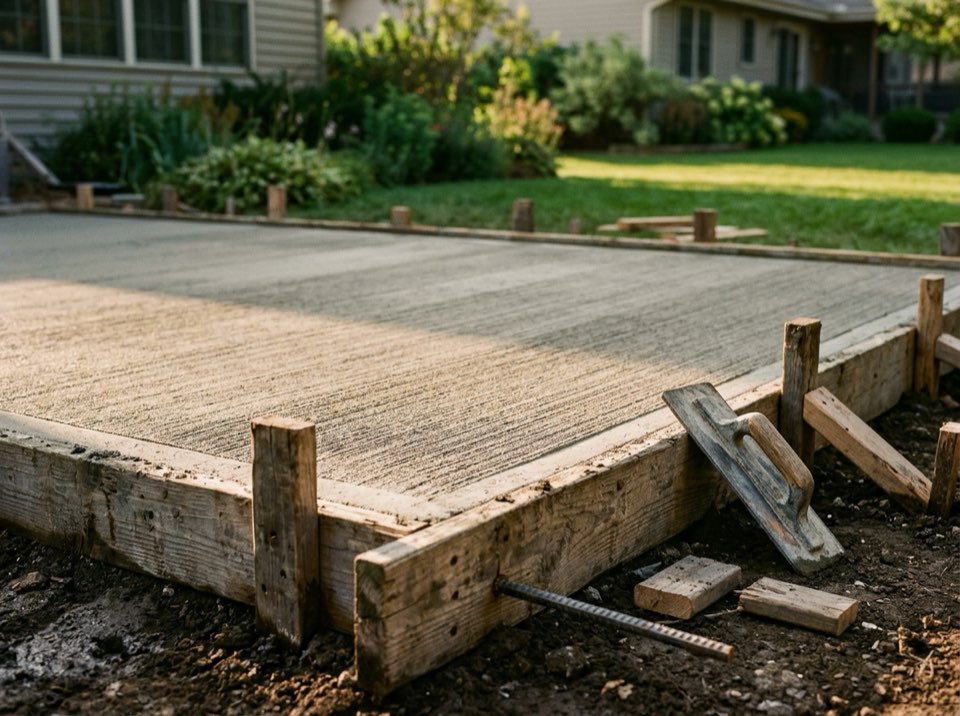
2×4×12 ft Form Lumber 68 lin ft perimeter forming | 7 boards | $54.95 | |
24" Steel/Wood Form Stakes (Bundle of 10) Spaced every 3 ft (23 stakes total) + duplex nails | 3 bundles | $66.00 |
Concrete field reference
Quick formulas, slab thicknesses, and pour checks.
Formula & waste allowance
Convert all slab dimensions to feet, divide cubic feet by 27 to get cubic yards, and add 10% waste for uneven gravel subgrade and form flex before rounding ready-mix truck orders to the nearest 0.25 yd³.
Quick sizing chart
| Project type | Thickness | Base & reinforcement | Per 100 sq ft |
|---|---|---|---|
| Walkway or patio | 4 in | 4″ crushed stone + wire mesh | 1.23 yd³ (56 × 80-lb bags) |
| Hot tub or shed pad | 5 – 6 in | 4″–6″ stone + #4 rebar @ 18″ | 1.85 yd³ at 6″ (84 bags) |
| Passenger driveway | 5 – 6 in (4,000 PSI) | 6″ stone + #4 rebar @ 16″–18″ | 1.54 yd³ at 5″ + 10% waste |
| RV pad or heavy apron | 6 – 8 in (4,500 PSI) | 6″–8″ road base + #4 rebar @ 12″ | 2.47 yd³ at 8″ (ready-mix) |
Worked example: 20′ × 14′ patio at 4″ thick
- Net slab volume: 20 ft × 14 ft = 280 sq ft × (4 ÷ 12) ft = 93.33 ft³ ÷ 27 = 3.46 yd³ net.
- Waste & truck rounding: Add 10% waste (3.80 yd³) and round to quarter-yards → order 4.00 yd³ ready-mix.
- Compacted gravel base: 280 sq ft at 4″ deep = 3.46 yd³ × 1.42 tons/yd³ → order 5.5 tons crushed stone.
- #4 rebar grid (18″ O.C.): 10 lengthwise runs + 14 widthwise runs + lap splices → 22 sticks of 20-ft #4 rebar.
Jobsite checklist
- Call 811 at least 2–3 business days before digging.
- Check corner-to-corner diagonals so forms are square.
- Pitch exterior slabs 1/8″–1/4″ per foot away from walls.
- Cut control joints to 1/4 slab depth every 8–10 feet.
Common questions
How do you calculate cubic yards of concrete for a slab or patio?
Multiply slab length in feet by width in feet by thickness in feet (thickness in inches divided by 12) to get cubic feet, then divide by 27 cubic feet per cubic yard. Always add a 5% to 10% waste allowance for subgrade variations and form deflection, then round ready-mix orders up to the nearest 0.25 cubic yard.
How many 80-lb or 60-lb bags of concrete equal 1 cubic yard?
One 80-lb pre-mixed concrete bag yields approximately 0.60 cubic feet, requiring 45 bags per cubic yard. One 60-lb bag yields 0.45 cubic feet, requiring 60 bags per cubic yard. For pours above 1.75 to 2.0 cubic yards, ordering ready-mix concrete is typically faster and more economical than hand-mixing bags.
What is a ready-mix concrete short-load fee?
Most ready-mix batch plants set a minimum full-load threshold between 4 and 5 cubic yards. Orders below 4.0 cubic yards usually incur a flat short-load or minimum-haul fee ($125 to $275). DraftYard automatically flags pours under 4.0 yd³ so contractors include the delivery surcharge in their client bid.
How much compacted gravel base is needed under a 4-inch concrete patio?
A standard 4-inch compacted crushed stone base (#57 or 3/4-inch minus road base) weighs roughly 1.4 tons per cubic yard compacted. A 20 ft × 14 ft (280 sq ft) slab at 4 inches of base depth requires 3.46 cubic yards, or approximately 4.9 to 5.5 tons of crushed aggregate.
Should I use #4 rebar or 6×6 wire mesh in a residential concrete driveway?
For passenger vehicle driveways and heavy patios, #4 (1/2-inch) deformed steel rebar tied on an 18-inch on-center grid resting on 2-inch plastic chairs keeps steel centered in the slab structurally. Welded 6×6 W1.4×W1.4 wire mesh is common for light walkways, provided crews pull or chair it up rather than letting it sit at the bottom during the pour.