Stair stringer calculator
Exact step height, tread depth, stringer length and code checks.
- 1 Measure
- 2 Set your price
- 3 Quote & PDF
1 Measure
2 Set your price
USD3 Quote
Rounded to real store units. Edit any unit price to match your local supplier:
| Material | Buy qty | Unit (USD) | Cost |
|---|---|---|---|
2×12×10 ft #1 Grade PT Stringer Lumber 4 stringers spaced ≤16" O.C. across 48" stair width | 4 boards | $118.00 | |
2×6×12 ft Pressure-Treated Bullnose Tread Stock 7 treads (14 cut pieces @ 48" wide) | 5 boards | $72.50 | |
1×8×12 ft Fascia / Closed Riser Kickboards 8 uniform risers + bottom tread thickness drop accounted on 1st cut | 3 boards | $48.75 | |
Adjustable ZMAX Stair Stringer Connectors + Structural Screws 1 connector per stringer (4 total) at header/rim | 4 kits | $23.20 | |
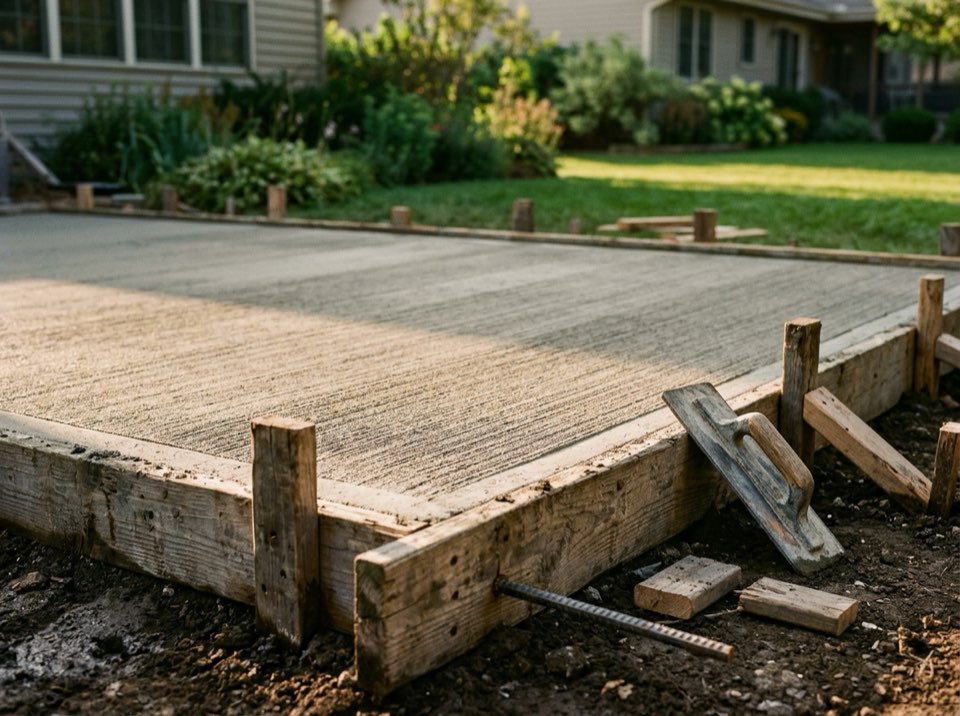
80-lb Concrete Bags (3 ft Bottom Stair Landing Pad) 4" thick frost-stable landing pad (48" × 36") | 7 bags | $45.36 |
2×12 stair stringer & code reference
IRC R311.7.5 riser rules, tread depth, and bottom heel drop.
Formula & waste allowance
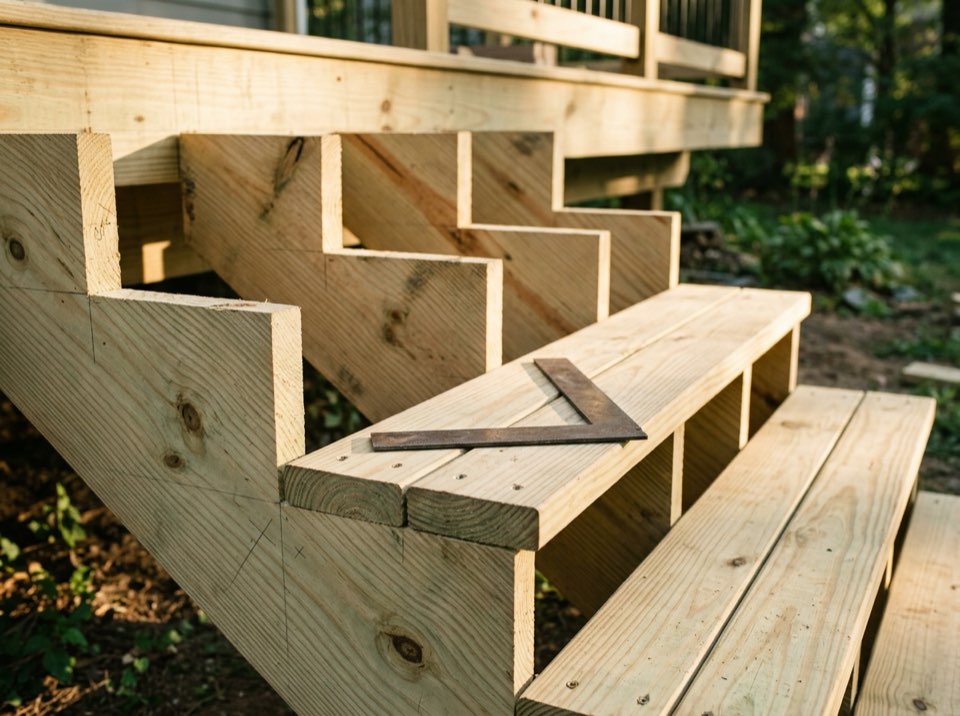
Divide finished deck-to-pad height by 7.75″ and round up so every step rises evenly under code max. Always trim your tread thickness (typically 1 1/2″) off the bottom heel of the stringer so the first step matches the rest.
Quick sizing chart
| Dimension | IRC code limit | Pro target | Mistake to avoid |
|---|---|---|---|
| Unit rise (step height) | 7 3/4″ max · 4″ min | 7″ to 7 1/2″ | Skipping the 1 1/2″ bottom heel drop |
| Unit run (tread depth) | 10″ minimum | 10 1/2″ – 11″ (two 2×6s) | Cutting 9″ treads that fail inspection |
| Flight riser variance | 3/8″ max difference | Within 1/8″ on concrete pad | Bearing stringers directly on dirt |
| Width & stringer spacing | 36″ min clear width | 48″ wide · stringers @ 16″ | Spanning 48″ on only 2 stringers |
Worked example: 4′ 10″ (58″) deck height, 48″ wide stairs
- Steps & exact rise: 58″ ÷ 7.75″ = 7.48 → 8 risers. Exact step height = 58″ ÷ 8 = 7 1/4″.
- Tread count & run: Drop-riser mount uses 7 cut treads × 10 1/2″ = 73 1/2″ (6′ 1 1/2″) total run.
- Bottom heel cut: Trim 1 1/2″ off the bottom horizontal heel cut to allow for 2×6 tread thickness.
- Lumber buy-list: Four #1 PT 2×12×10′ stringers, fourteen 2×6×4′ treads, and 4 hanger straps.
Jobsite checklist
- Select crown-up #1 2×12s keeping at least 5″ of uncut throat depth.
- Test-fit the first cut stringer with a level before tracing the rest.
- Fasten stringers with metal hanger straps instead of toe-nails.
- Seal fresh pressure-treated notch cuts with end-grain preservative.
Common questions
What is the maximum stair riser height and minimum tread depth under residential code?
Under International Residential Code (IRC R311.7.5), residential stair risers must not exceed 7-3/4 inches (7.75"), and tread depth measured horizontally nosing-to-nosing must be at least 10 inches (10.0"). Additionally, the largest riser height and smallest riser height within a flight cannot vary by more than 3/8 inch.
Why do you cut the bottom of a stair stringer shorter by the tread thickness?
Every step receives a finished tread (such as 1.5-inch thick 2×6 lumber) on top of the horizontal stringer cut. If you do not trim 1.5 inches ("drop the stringer") off the bottom heel of the stringer resting on the concrete landing pad, the bottom step becomes 1.5 inches taller than every other step and fails inspection.
What is the difference between a drop-riser mount and a flush-ledger stair mount?
In a standard drop-riser mount, the top of the stringer attaches one riser below the main deck surface so the deck itself acts as the top landing, meaning a flight with N risers has (N − 1) cut stringer treads. In a flush-ledger mount, the top stair tread sits flush with the deck surface, requiring N cut treads and a longer 2×12 board.
How many 2×12 stair stringers do I need for a 36-inch, 48-inch, or 60-inch wide deck stair?
Wood 2×6 treads are commonly supported on 16-inch maximum stringer centers (12-inch centers for composite stair treads). A 36-inch stair uses 3 stringers, a 48-inch stair uses 4 stringers, and a 60-inch stair uses 5 stringers, keeping at least 5 inches of uncut throat depth on a #1 grade 2×12.
When is a stair handrail and concrete landing pad required?
Residential building codes require a continuous graspable handrail (34 to 38 inches vertically above stair nosings) on flights with 4 or more risers, plus a solid, level landing pad at least 36 inches deep by the full stair width at the bottom of exterior stairs.